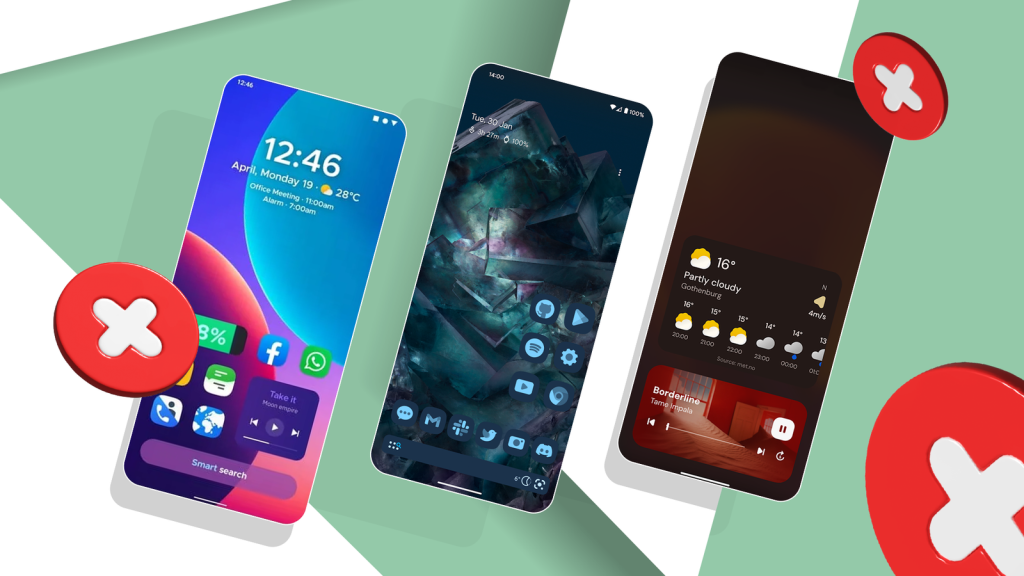

For years, the first thing I did after getting a new Android phone was install a custom launcher and set it up just the way I wanted.
Nova Launcher remained my go-to for years before I eventually moved to Smart Launcher.
But in recent years, I have stopped bothering with custom launchers entirely. It’s not like they have gotten worse. If anything, they are better than ever.
The problem is that Android increasingly makes custom launchers feel like second-class citizens.
Gesture navigation never feels quite right
All those tiny annoyances add up
The biggest reason I stopped using custom launchers is that they partially broke Android’s gesture navigation.
On paper, thanks to Android’s openness, you can download and install a third-party custom launcher from the Play Store to replace your phone’s stock launcher.
It is only when you start using the phone in daily life that you realize how broken the experience is.
With the stock launcher, Android’s gesture navigation works perfectly. Swipe up to go home, swipe up and hold to enter the Recents menu, or quickly jump between apps with a quick left or right swipe.
Everything works as expected, with smooth animations and no lag.
Everything falls apart when you switch to a custom launcher, especially on non-Pixel phones.
The swipe up to go to the home screen animation starts stuttering, the Recent apps menu takes a few seconds to load, and there are random animation glitches and lag.
Quickly jumping between an app and the home screen also almost always creates unwanted issues.

There is another annoyance that I frequently run into with third-party launchers accessing Google Discover.
With Pixel Launcher, the Discover feed is always accessible from the leftmost home screen page. Most third-party launchers can’t offer the same seamless integration.
Some work around this by requiring a separate companion app or plugin to enable Discover access. But even then, the execution is nowhere as good as it is with the stock launcher. There are animation glitches or bugs that ruin the experience.
The experience varies depending on the phone and launcher, and while things have improved in recent years, they are still nowhere near perfect.
Some manufacturers like Xiaomi place more restrictions around gesture navigation when using third-party launchers. Samsung and Google phones fare relatively better in this regard.
Android doesn’t give every launcher an equal playing field
Changing your home screen shouldn’t be this hard

These issues stem from Android using the stock launcher for more than displaying icons, widgets, and the app drawer.
So while you can set a third-party launcher as the default home app on your phone, the system handles navigation gestures.
That’s an integration only the stock launcher can enjoy, not one that you download from the Play Store.
The frustrating part is that these issues are not something that third-party launcher developers can fix. It is up to Google and individual Android device manufacturers.
If anything, calling third-party launchers “custom home screens” feels more accurate than ever. They don’t completely replace the stock launcher. They only radically change what the home screen looks like and how it behaves.
Custom launchers are still better
Though the gap is closing

For all the advancements and improvements that stock launchers across Android devices have received in recent years, custom launchers are still better. They are more customizable and flexible, allowing me to set up my home screen the way I want.
My current favorite launcher is Smart Launcher, which can organize my app drawer in a better way, allow me to change icons and layouts, use gestures for app shortcuts, and more.
Most stock launchers don’t come close. At best, they support custom icon packs, but that’s about it.
Pixel Launcher is the best example of this. I love its smooth animations and tight integration with Android, but it offers basic customization options. There are widgets on the home screen that I cannot remove.
The layout is just not flexible enough, and custom icon pack support is non-existent. And no, support for AI-powered custom icons does not count.
Due to this, I keep yo-yoing between Pixel Launcher and Smart Launcher. I start with Pixel Launcher, grow frustrated with its limitations, and switch to Smart Launcher.
Then, eventually, the little navigation inconsistencies start bothering me, and I find myself switching back to Pixel Launcher.
I want to use custom launchers again

I have mostly stopped using custom launchers, but not because I have lost interest in customizing Android. I stopped because that customization is not worth sacrificing basic navigation fluidity.
For an OS that is all about its openness and choices, it’s a shame that third-party launchers still don’t work as smoothly as the stock launcher on many Android devices.
Google deserves some of the blame here. It controls the direction of the Android ecosystem, and it should ensure that device manufacturers don’t intentionally or unintentionally break the experience for third-party launchers.
I don’t want Google to make Pixel Launcher as customizable as Smart Launcher. I’d much rather it gave third-party launchers the tools and access they need to deliver an equally polished experience.
PakarPBN
A Private Blog Network (PBN) is a collection of websites that are controlled by a single individual or organization and used primarily to build backlinks to a “money site” in order to influence its ranking in search engines such as Google. The core idea behind a PBN is based on the importance of backlinks in Google’s ranking algorithm. Since Google views backlinks as signals of authority and trust, some website owners attempt to artificially create these signals through a controlled network of sites.
In a typical PBN setup, the owner acquires expired or aged domains that already have existing authority, backlinks, and history. These domains are rebuilt with new content and hosted separately, often using different IP addresses, hosting providers, themes, and ownership details to make them appear unrelated. Within the content published on these sites, links are strategically placed that point to the main website the owner wants to rank higher. By doing this, the owner attempts to pass link equity (also known as “link juice”) from the PBN sites to the target website.
The purpose of a PBN is to give the impression that the target website is naturally earning links from multiple independent sources. If done effectively, this can temporarily improve keyword rankings, increase organic visibility, and drive more traffic from search results.