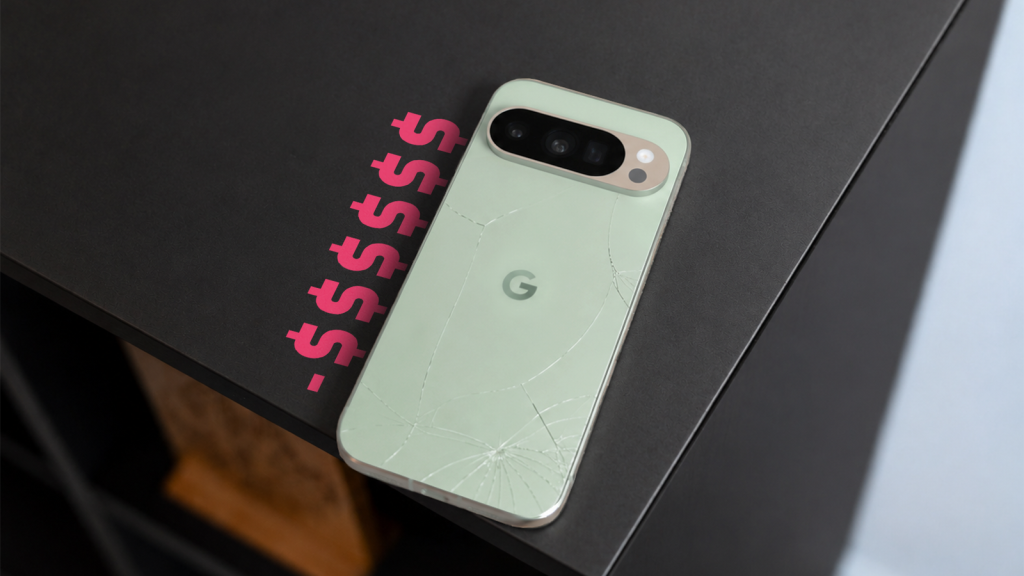

Phone costs are rising, and AI is to blame. RAM prices are skyrocketing, and manufacturers are passing the costs to consumers.
Compromising on memory is the standard way manufacturers compensate for higher costs, and that’s forcing us to make tough decisions.
But the whole discussion around phone costs has made me consider other ways manufacturers and consumers could save money. After much consideration, I think there’s one obvious feature that should be canned.
Glass is a symbol of price, not quality
It’s there for looks, not durability
Pick up any flagship smartphone, and you’ll notice one thing in common: Glass. From iPhones to Google Pixels, the glass back is the trademark of modern smartphones.
But why?
Several myths about glass backs are bandied about in conversations about smartphone construction, but there are only three major factors at play: scratch resistance, look, and cost.
My Pixel 10 Pro has a Corning Gorilla Glass Victus 2 matte glass back that remains completely scratch-free after a year of use.
While I’m not poking it with a knife, the phone regularly shares space with my keys, which haven’t inflicted even minor damage.

It’s seriously hard to scratch the glass on modern smartphones, and that’s great! But it’s not the only reason manufacturers build phones with glass.
The second factor, look, is all-important. Glass exudes an aura of quality and premium materials, which is what manufacturers rely on to sell phones.
It doesn’t matter how effective polycarbonate is (more on that later); it just doesn’t scream quality like glass. Forget facts; looks matter here.

Finally, cost. Phones with glass construction cost more than plastic. Manufacturers compensate by raising the price.
Polycarbonate has its own disadvantages (slightly more vulnerable to scratches, a perceived “cheapness”). However, it’s more resistant to drops, and it’s much cheaper to manufacture and replace.
The cost of plastic versus glass
A more expensive material that you don’t need
It’s hard to get an exact measure of how much money a manufacturer would save by replacing a phone’s glass body with plastic, but we can estimate.
The Samsung Galaxy S20 cost $1,000 at launch and shipped with a glass back. The Galaxy S21, on the other hand, cost $800 at launch and shipped with a plastic back.
Admittedly, the Galaxy S21 had a lower-resolution display, lower RAM capacity (note this is 2021, well before the RAM crisis), and a 1080p screen.

However, it had a stronger camera, better battery optimization, improved biometrics, and a faster processor.
We can also compare replacement parts for the Pixel 10 and the Pixel 10a from iFixit.
A replacement glass back cover for the Pixel 10 costs $90. A replacement plastic back cover for the Pixel 10a costs $40.
There are more factors at play here, including manufacturing needs and marketing decisions, but the short answer is that plastic is cheaper than glass.
But here’s the kicker: Glass is pointless anyway.
The benefits of glass are rendered pointless with the one accessory everyone owns
How often do you see a caseless phone?
I pointed out earlier in this article that my Pixel 10 Pro’s fancy glass back has never picked up a single scratch despite living with my keys for hours each day.
It sounds impressive, but I deliberately ignored a crucial point.
Except for the brief period after buying the phone and when I replaced my official Google case, my Pixel 10 Pro has been securely wrapped in a protective casing since I powered it on.

Sure, the white Corning Gorilla Glass Victus 2 matte glass back looks cool and is super-resistant to scratches, but I don’t particularly care.
Google could have replaced the glass with polycarbonate, knocked $100 or more off the retail price, and it would have made zero difference to my experience.
But Google has to copy Apple, so here we are.
Sure, I could walk around showing my Pixel 10 Pro’s exposed rear to the world, but I’m risking $100 with every drop.
Perception of quality is raising prices just as much as the RAM crisis
What makes a phone good quality? Performance, cameras, battery life. These factors play a part in what we perceive as good value.
But I think that perceived quality is a more significant factor.
The glass back on flagships doesn’t actually improve a phone. It’s perceived as higher quality than plastic, which is why most phones with plastic construction are marketed as budget-friendly devices (for example, the Pixel 10a).
Google is trying to argue that it’s doing the best it can to stop prices from rising even further.
But the reality is that it and other manufacturers are not making the consumer-friendly decisions needed to reduce costs.
Flagship devices like the Pixel 10 and Galaxy S26 are powerful devices packed with utility. But they could be cheaper without impacting our experience.
PakarPBN
A Private Blog Network (PBN) is a collection of websites that are controlled by a single individual or organization and used primarily to build backlinks to a “money site” in order to influence its ranking in search engines such as Google. The core idea behind a PBN is based on the importance of backlinks in Google’s ranking algorithm. Since Google views backlinks as signals of authority and trust, some website owners attempt to artificially create these signals through a controlled network of sites.
In a typical PBN setup, the owner acquires expired or aged domains that already have existing authority, backlinks, and history. These domains are rebuilt with new content and hosted separately, often using different IP addresses, hosting providers, themes, and ownership details to make them appear unrelated. Within the content published on these sites, links are strategically placed that point to the main website the owner wants to rank higher. By doing this, the owner attempts to pass link equity (also known as “link juice”) from the PBN sites to the target website.
The purpose of a PBN is to give the impression that the target website is naturally earning links from multiple independent sources. If done effectively, this can temporarily improve keyword rankings, increase organic visibility, and drive more traffic from search results.