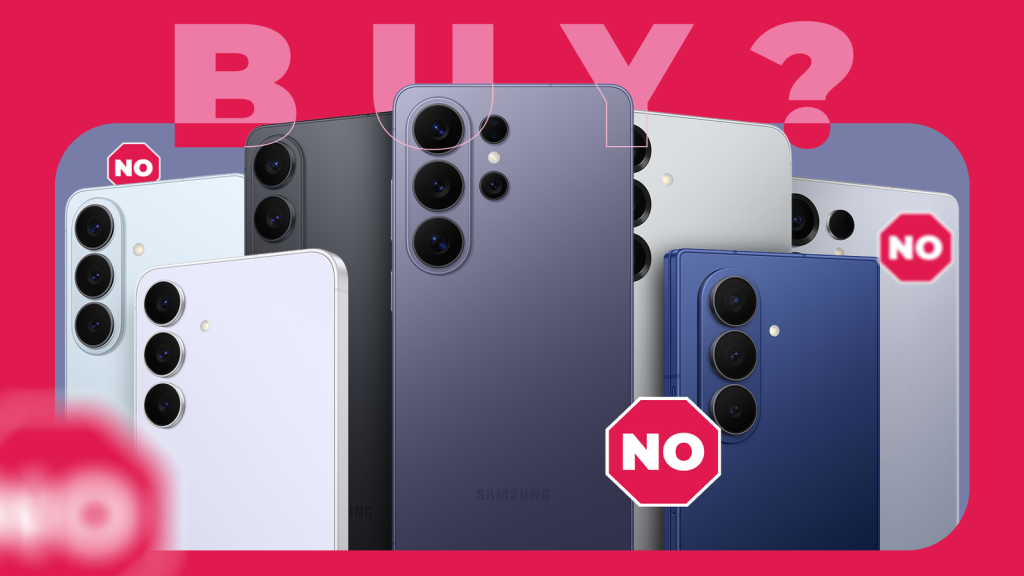

Summer tech sales are about to get tricky. Amazon Prime Day runs from June 23 to 26 this year, with Walmart Deals starting June 22 and Target Circle Deal Days overlapping from June 23 to 26.
But before you start clicking through Lightning Deals, there’s a problem worth knowing about. Samsung recently raised retail prices across its lineup heading into summer.
Bottom line? A lot of discounts could be dressed-up price resets. The baseline tells you whether it is actually worth it.
This is how much more your smartphone will cost because of AI
Manufacturers are finding ways to save money elsewhere, but will it be enough?
The likely reason Galaxy prices jumped mid-cycle

The AI infrastructure buildout is eating high-bandwidth memory at a historic pace, and chipmakers are funneling production into enterprise AI contracts instead of consumer parts.
A fully configured Nvidia Vera Rubin NVL72 rack can use 54TB of LPDDR5X, roughly the RAM found in about 4,500 to 4,600 12GB Galaxy S26 Ultra phones.
With that kind of demand, consumer electronics have less room to compete for the same memory supply. Samsung co-CEO TM Roh warned earlier this year that price increases were unavoidable.
There’s only so long any company can eat costs like that before passing them to shoppers.

Why your next Android upgrade is about to cost $100 more for the same specs
Android upgrades are becoming a bad deal
Where the new baseline actually sits
Spring 2026 data shows the biggest markups hit high-storage models and the tablet lineup.
The S26 series is a different story. Those prices were set at launch, and there has not been a confirmed US post-release MSRP hike.
Likewise, other devices in the Galaxy ecosystem do not appear to be part of the same post-release MSRP increase.
Samsung phones with price increases
|
Device |
Storage |
Old MSRP |
June 2026 MSRP |
Increase amount |
|---|---|---|---|---|
|
Galaxy Z Fold 7 |
512GB |
$2,120 |
$2,200 |
$80 |
|
Galaxy Z Fold 7 |
1TB |
$2,420 |
$2,500 |
$80 |
|
Galaxy Z Flip 7 |
512GB |
$1,220 |
$1,300 |
$80 |
|
Galaxy S25 FE |
256GB |
$710 |
$750 |
$40 |
|
Galaxy S25 Edge |
512GB |
$1,220 |
$1,300 |
$80 |
Samsung tablets with price increases
|
Device |
Storage |
Old MSRP |
June 2026 MSRP |
Increase amount |
|---|---|---|---|---|
|
Galaxy Tab S11 |
128GB |
$800 |
$900 |
$100 |
|
Galaxy Tab S11 |
256GB |
$860 |
$1,000 |
$140 |
|
Galaxy Tab S11 |
512GB |
$980 |
$1,200 |
$220 |
|
Galaxy Tab S11 Ultra |
256GB |
$1,200 |
$1,300 |
$100 |
|
Galaxy Tab S11 Ultra |
512GB |
$1,320 |
$1,500 |
$180 |
|
Galaxy Tab S11 Ultra |
1TB |
$1,620 |
$1,900 |
$280 |
|
Galaxy Tab S10 FE |
128GB |
$500 |
$550 |
$50 |
|
Galaxy Tab S10 FE |
256GB |
$570 |
$670 |
$100 |
|
Galaxy Tab S10 FE Plus |
128GB |
$650 |
$700 |
$50 |
|
Galaxy Tab S10 FE Plus |
256GB |
$750 |
$820 |
$70 |
|
Galaxy Tab S10 Lite |
128GB |
$350 |
$400 |
$50 |
|
Galaxy Tab S10 Lite |
256GB |
$420 |
$490 |
$70 |
|
Galaxy Tab S10 Plus |
256GB |
$1,000 |
$1,100 |
$100 |
|
Galaxy Tab S10 Plus |
512GB |
$1,120 |
$1,300 |
$180 |
|
Galaxy Tab A11 Plus |
128GB |
$250 |
$300 |
$50 |
|
Galaxy Tab A11 Plus |
256GB |
$310 |
$380 |
$70 |
|
Galaxy Tab A11 Plus 5G |
128GB |
$280 |
$330 |
$50 |
How to spot a fake discount

Retailers love percentage-off badges and countdown timers, so stay skeptical. The inflated MSRP can become a false anchor that makes mediocre cuts look generous.
CamelCamelCamel and similar trackers show how Amazon prices have moved over time, so you can tell whether a Lightning Deal is actually lower than it was a few months ago. There are, however, some blind spots.
Trackers are tied to specific product listings, so if a retailer launches a separate listing for Prime Day or another sale, the price history may be incomplete. They also tend to miss discounts that come through checkout codes.
Where the real deals are hiding

Some configurations survived the worst of the markups. On the phone side, Samsung mostly spared the entry-level storage tiers.
The base 256GB Galaxy Z Fold 7, for example, held its $2,000 launch price. If you target base models and skip the top storage tiers, your money stretches further this summer.
Older inventory is another sweet spot. Retailers could be clearing old stock without resetting every price around the new baselines.
Open-box units at the big chains are also worth checking out, especially at major retailers like Best Buy, Walmart, and Amazon.
These products are often priced more dynamically and are more likely to be priced based on the old MSRPs.
Samsung phone configurations that did not change
|
Device |
Storage |
Old MSRP |
June 2026 MSRP |
Increase amount |
|---|---|---|---|---|
|
Galaxy Z Fold 7 |
256GB |
$2,000 |
$2,000 |
$0 |
|
Galaxy Z Flip 7 |
256GB |
$1,100 |
$1,100 |
$0 |
|
Galaxy S25 FE |
128GB |
$650 |
$650 |
$0 |
|
Galaxy S25 Edge |
256GB |
$1,100 |
$1,100 |
$0 |
Trade-ins are doing the heavy lifting
For buyers chasing maximum storage or the latest model, trade-in promos may be the easiest way to offset the new price bumps.
As of June 2026, Samsung is offering up to $720 credit toward a Galaxy S26 Ultra.
Hitting that ceiling takes a recent premium trade like a Z Fold 6, but the credit applies at checkout with no carrier contract attached.
Carriers go further. Verizon is offering up to $1,300 in promotional billing credits for customers trading in a qualified tier-one phone and signing up for a new unlimited plan.
The trade-off is the lock-in, so do the math on a 36-month carrier deal versus an unlocked direct purchase before you commit.
PakarPBN
A Private Blog Network (PBN) is a collection of websites that are controlled by a single individual or organization and used primarily to build backlinks to a “money site” in order to influence its ranking in search engines such as Google. The core idea behind a PBN is based on the importance of backlinks in Google’s ranking algorithm. Since Google views backlinks as signals of authority and trust, some website owners attempt to artificially create these signals through a controlled network of sites.
In a typical PBN setup, the owner acquires expired or aged domains that already have existing authority, backlinks, and history. These domains are rebuilt with new content and hosted separately, often using different IP addresses, hosting providers, themes, and ownership details to make them appear unrelated. Within the content published on these sites, links are strategically placed that point to the main website the owner wants to rank higher. By doing this, the owner attempts to pass link equity (also known as “link juice”) from the PBN sites to the target website.
The purpose of a PBN is to give the impression that the target website is naturally earning links from multiple independent sources. If done effectively, this can temporarily improve keyword rankings, increase organic visibility, and drive more traffic from search results.